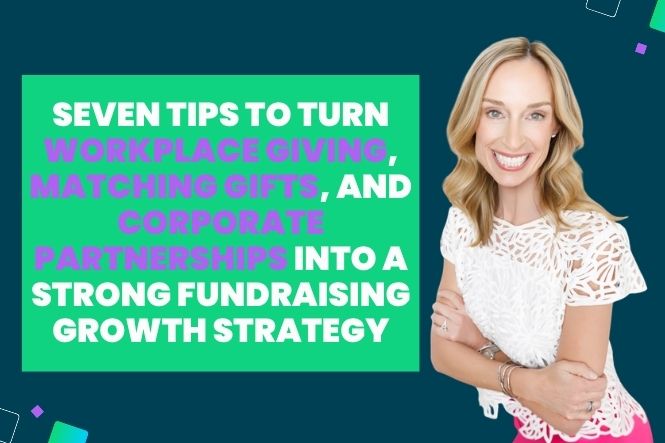
Seven Tips to Turn Workplace Giving, Matching Gifts, and Corporate Partnerships Into a Strong Fundraising Growth Strategy
October 6, 2026 | 12 min read
Key Takeaways
- Treat workplace giving as a year-round fundraising and relationship-building strategy, not just another way donations arrive.
- Trust is the infrastructure behind successful workplace giving. Accurate nonprofit information, verification, secure payment details, and strong processes help generosity move with less uncertainty.
- Faster fund delivery helps nonprofits act sooner and connect with donors while their motivation to give is still fresh.
- Donor and employer data can help fundraisers turn workplace gifts into opportunities for stronger individual donor relationships and potential corporate partnerships.
- The strongest workplace giving strategies connect the entire ecosystem: employee donors, companies, and nonprofits.
Workplace giving is sometimes treated as a passive revenue source. A donation arrives through an employer program, the development team records it, and everyone moves on to the next gift. That view leaves significant opportunity on the table.
I recently joined leaders from Blackbaud, Charleston Animal Society, and Double the Donation for a conversation about the future of workplace giving. What became clear throughout the discussion is that workplace giving is much bigger than a single transaction.
Done well, it can help nonprofits deepen donor relationships, identify potential corporate partners, increase matching gift revenue, expand their visibility, and get funds to their mission faster.
That requires a shift in thinking from “How do we receive workplace donations?” to “How do we turn workplace giving into a stronger part of our overall fundraising strategy?”
Double the Donation’s 2026 research found that 49% of nonprofits identified workplace giving as a growth strategy, while 93% believed they could grow the amount they raise through corporate giving programs.
Here are seven proven ways to leverage workplace giving programs for long-term fundraising success.
1. Treat Workplace Giving as a Relationship, Not a Transaction
Always treat a workplace gift as part of an ongoing relationship. Andrew Troup, chief impact officer for YourCause from Blackbaud, made an important point during our discussion: Better donor information can help nonprofits understand not only who gave, but also whether the gift came through a workplace program and whether a company match may be connected to it.
That context changes what a fundraiser can do next. Instead of simply recording the transaction, you can:
- Thank the donor
- Learn what motivated the gift
- Determine whether matching opportunities exist
- Invite the supporter to volunteer
This helps build a longer-term relationship.
The same data can reveal another opportunity: the employer. If several employees from the same company are donating or volunteering, that activity is a signal to explore a deeper corporate relationship, whether through volunteering, sponsorships, grants, or other forms of engagement. Fundraisers don’t always need to start corporate outreach cold. Sometimes your next corporate relationship is already visible with your existing supporters.
2. Make Trust Part of Your Fundraising Infrastructure
I believe trust is the foundation of all giving, including workplace giving. Employee donors need confidence that their charitable intent will be honored. Companies need confidence that funds are reaching legitimate organizations. Nonprofits need confidence that grants will arrive accurately, securely, and efficiently. Creating that confidence requires work that fundraisers may never see.
At The Blackbaud Giving Fund, risk mitigation is built throughout the grant-making process, including nonprofit eligibility verification, ongoing due diligence, monitoring for status changes, and regulatory compliance. That work is critical because donors and nonprofits shouldn’t have to think about it every time a gift is made.
Trust may be invisible, but it is the infrastructure that allows generosity to scale. Fundraisers have an important role in building trust, too:
- Keep your organization’s information accurate wherever donors and companies may encounter you
- Make sure contact information is current
- Maintain accurate payment information
- Make someone responsible for all giving profiles, including workplace giving platforms like Blackbaud Verified Network
- Keep your mission, stories, and impact information fresh
These may sound like administrative tasks, but they’re actually trust signals. When the information surrounding your organization is consistent, accurate, and current, you reduce friction between donor intent and nonprofit impact.
3. Think of Year-End Readiness as Trust Readiness
This is particularly important as giving season approaches. Too many nonprofits wait until donations arrive to discover that an administrator has left the organization, banking information needs updating, or a profile is outdated. The strongest year-end fundraising teams do the opposite. They remove those obstacles before donor activity increases. I call this trust readiness.
Every nonprofit should be able to answer basic questions before the busiest fundraising period begins:
- Is our information accurate?
- Is someone actively managing our giving profiles?
- Is our electronic payment information current?
- Do we know how to access available donor information?
- Do we have a process for thanking donors quickly?
For nonprofits using Blackbaud Verified Network, keeping administrators active is especially important. Administrators can maintain organizational information, establish ACH details, and manage attestations that may be required for corporate programs. Do this work before December so you can use giving season to execute your fundraising strategy, not rebuild the infrastructure supporting it.
4. Make Speed Part of the Donor Experience
Fundraisers naturally think about faster donations in terms of cash flow. That matters, but speed also affects your ability to build relationships. Kristen Lewis, director of donor relations and reporting at Charleston Animal Society, brought the nonprofit perspective to the webinar. Her experience illustrated that when a workplace gift arrives quickly and the donor opts to share their information, her team can reach out while the reason for giving is still fresh. They can thank the donor, learn what inspired the gift, and begin the next conversation.
If they wait 60 or 90 days, that moment looks very different. A donor may barely remember the original interaction that prompted the gift, the fundraiser loses valuable context, and the nonprofit goes weeks without funds it could have already put toward its mission. That’s why we need to prioritize the speed of need—the distance between generosity and impact matters. As I’ve previously written about the hidden costs of slow donations, delays can affect nonprofit planning, cash flow, campaign momentum, and donor trust.
Faster giving can also shorten another important gap: the time between a donor saying, “I want to help,” and the nonprofit saying, “Here is what your generosity made possible.” That’s a fundraising advantage.
5. Stop Leaving Matching Gifts to Chance
Another relatively simple question fundraisers should ask supporters: Does your employer match charitable gifts? Matching programs increase the impact of generosity a nonprofit has already inspired, but donors don’t always know what their employers offer.
Double the Donation’s 2026 research reports that more than 26 million people work for companies with matching gift programs, yet donor awareness remains a major barrier. Its Q3 research found that 31% of nonprofits identified low supporter awareness as their biggest workplace giving challenge.
That makes matching-gift education a fundraiser’s responsibility:
- Include matching-gift prompts in donation acknowledgments
- Mention workplace giving in newsletters
- Ask donors about their employers when appropriate
- Incorporate matching into year-end communications
- Make the opportunity visible on your website
Most importantly, don’t assume donors already know.
You worked hard to earn the original gift. Before focusing exclusively on acquiring another donor, make sure you are maximizing the generosity of the people who have already chosen your mission.
6. Use Workplace Giving Data to Find Corporate Opportunities
One of my favorite ideas from our webinar came from Andrew: Think about workplace giving as an ecosystem connecting nonprofits, employees, and companies. Multiple employees from one company supporting your organization can be more than a collection of individual gifts. Employees volunteering with your nonprofit, requesting matches, logging board service, or participating in incentive programs can all provide useful signals to inform your corporate outreach efforts.
Review workplace giving activity and ask:
- Which employers appear most often among our supporters?
- Do employees from the same company donate or volunteer?
- Are corporate matches accompanying those gifts?
- Do any of our board members, donors, volunteers, or staff have relationships within those companies?
- Does our mission align with the company’s stated social impact priorities?
- Could we provide the company with meaningful impact information to share with employees?
The goal is to turn data into a conversation. Employee generosity can create the first connection. Thoughtful stewardship can help fundraisers determine whether there is a larger relationship is worth developing.
7. Build a Workplace Giving Playbook
Andrew offered another practical recommendation: build a workplace giving playbook. Workplace giving should not depend on one employee knowing where a password lives or remembering how a particular donation was handled last year. Nonprofits must document the process:
- Identify who owns workplace giving
- Define how incoming gifts are reconciled
- Determine where donor information is reviewed
- Establish a stewardship process
- Document what happens when information is missing
- Decide how employer trends are surfaced to development leadership
A simple process can make workplace giving much easier to manage when volume increases.
Workplace Giving Readiness Check
Before your next major campaign, ask your team:
Visibility
- Is our organization’s information accurate across workplace giving platforms?
- Are our mission, impact stories, images, and contact information current?
- Have we claimed and updated our free Blackbaud Verified Network profile?
Fund Delivery
- Is our payment information accurate?
- Are we enrolled in available electronic payment options such as ACH?
- Do we know who monitors incoming workplace donations?
Donor Stewardship
- Do we regularly review available donor information?
- Do workplace donors receive timely acknowledgment?
- Do we ask supporters whether their employers offer matching gifts?
- Can we quickly connect a donor with a recent story showing the impact of their support?
Corporate Opportunity
- Do we review employer information for patterns among donors and volunteers?
- Do we have a process for flagging companies with multiple engaged employees?
- Are we looking beyond donations to volunteering, matching gifts, grants, sponsorships, and other partnership opportunities?
If several of these questions are difficult to answer, the opportunity to integrate workplace giving into your fundraising strategy may be bigger than you realize.
The Future of Workplace Giving Is Connections
The future of workplace giving is not simply about processing more transactions. It’s about creating stronger connections with people who want to give, companies that want to support their employees’ generosity, and nonprofits that can turn those resources into impact.
That requires speed, transparency, and infrastructure. But it also requires fundraisers to recognize the opportunity in front of them. Update your profiles. Understand where your workplace gifts are coming from. Educate donors about matching. Thank supporters quickly. Look for patterns in employer engagement. Share impact with donors and companies.
Workplace giving can start with a single employee making a gift. Your strategy determines what happens next.
Ready to reach over 9 million potential donors and bring your workplace giving strategy to the next level? Sign up for the free Blackbaud Verified Network.
Explore more free strategies on our blog, including how to turn volunteers into long-term donors, attract new donors leveraging AI, build strong corporate partnerships, and more.
To learn more about The Blackbaud Giving Fund, visit BlackbaudGivingFund.org or follow the organization on LinkedIn, Facebook, and Instagram for updates, news, and more.